
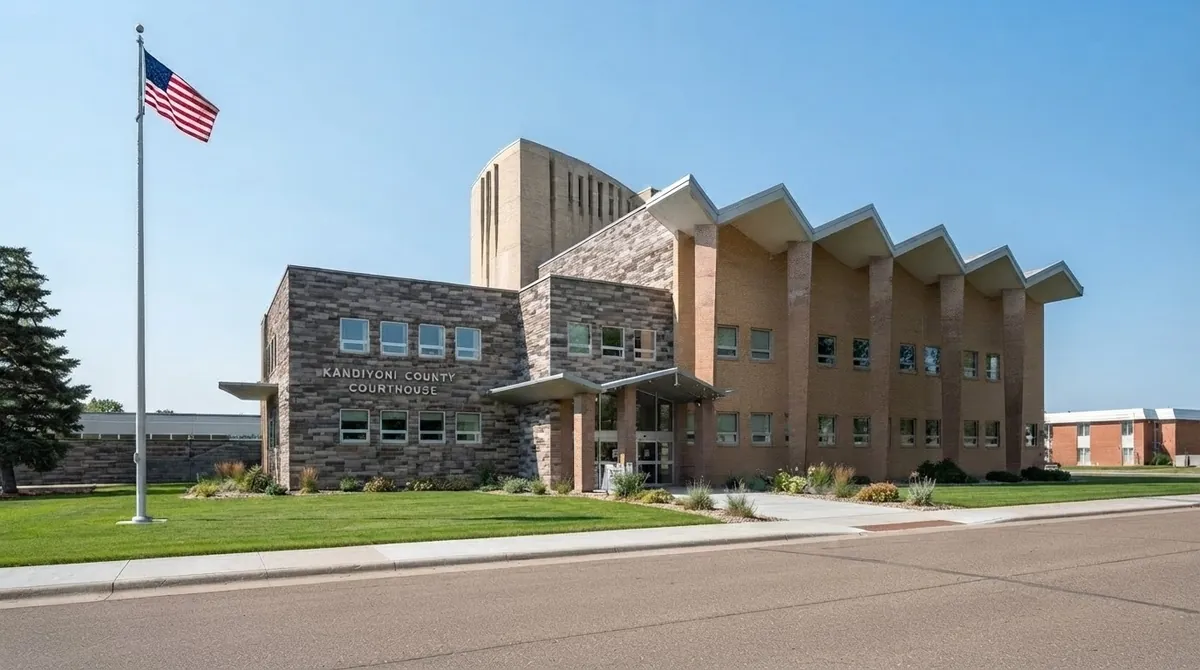
Court records in Kandiyohi County, Minnesota, are maintained by the district court clerk's office and are accessible through online tools, official court portals, and directly at the court clerk's office. KandiyohiCourt.us will help you find publicly available information about court cases in this county. Additional sources include the Minnesota Court Records Online (MCRO) system, the Kandiyohi County District Court page on the Minnesota Judicial Branch website, and the court administrator's office in the courthouse in Willmar.
Kandiyohi Court System Overview
Kandiyohi County is part of the 8th Judicial District of Minnesota. This district includes thirteen counties in the central and western parts of the state, including Kandiyohi, Chippewa, Grant, Lac qui Parle, Meeker, Pope, Renville, Swift, and others. The Kandiyohi County District Court has primary jurisdiction over all civil, family, probate, juvenile, criminal, and traffic cases.
The courthouse is located in Willmar:
The court operates on business days. For confirmation of operating hours, contact the local court administrator's office. Minnesota does not have separate magistrate courts—all cases are heard by the single District Court.
Courts Serving Kandiyohi
Residents of the county are served by several state and federal court levels.
State District Court
Federal District Court
Kandiyohi County falls under the jurisdiction of the U.S. District Court for the District of Minnesota. The nearest federal courts are located in Minneapolis and Fergus Falls.
Federal Bankruptcy Court
Bankruptcy cases are handled by the U.S. Bankruptcy Court for the District of Minnesota at the same address in Minneapolis.
There are no municipal courts within Kandiyohi County—all local level cases are heard by the state district court.
What Types of Cases Kandiyohi Courts Hear
The Kandiyohi District Court hears a wide range of cases. Here are the main categories:
- Criminal cases: felonies, misdemeanors, petty misdemeanors
- Civil cases: claims of any amount, including small claims (up to $15,000)
- Family law: divorce, custody, child support, paternity establishment, protective orders
- Probate cases: estate administration, guardianship, conservatorship, trusts
- Juvenile cases: juvenile offenses, child protection cases, adoptions
- Traffic violations and DUI/DWI
District Court Cases in Kandiyohi
Minnesota operates a unified district court system, so there is no separate magistrate court in Kandiyohi. The district court hears all criminal cases—from minor offenses to serious crimes. Serious criminal cases typically begin with the defendant's first appearance before a judge, after which the case is assigned to a specific judge in the 8th Judicial District.
Civil claims of significant amounts, appeals of arbitration decisions, and post-judgment proceedings also fall under the district court's jurisdiction. Cases are distributed among judges according to the county's internal rules. If you need to file a case, use the information on the Kandiyohi court page.
Magistrate Court Cases in Kandiyohi
Minnesota does not have a separate magistrate system. Instead, the district court handles cases of all levels, including those that would fall under a magistrate court in other states:
- Misdemeanors and petty misdemeanors
- Traffic violations and DUI/DWI cases
- Preliminary hearings in criminal cases
- Small claims (conciliation court / small claims) — up to $15,000 according to Minnesota law
Conciliation court is a simplified procedure for small civil disputes where parties often represent themselves. Decisions of this court can be appealed in the district court through a trial de novo. Traffic violation and DWI cases are heard by judges in the same courthouse in Willmar.
Family Law, Probate, and Juvenile Matters in Kandiyohi
Family Law
Divorce, child custody, child support, protective orders (Orders for Protection), paternity establishment, and termination of parental rights are all handled by the Kandiyohi District Court. A certified copy of a divorce decree can be obtained from the court clerk's office where the case was heard; the State Law Library explains the process for obtaining such documents.
Probate Matters
Probate matters (estate administration, appointment of a guardian or conservator, trust issues) also fall under the district court's jurisdiction. Documents can be viewed through MCRO, although some probate records may have limited remote access.
Juvenile Matters
Juvenile offenses and child protection cases are confidential under Minnesota law. Information about them is not published in publicly accessible online systems. For inquiries regarding juvenile cases, contact the court clerk's office directly at (320) 231-6206.
How Cases Move Through the Kandiyohi Court System
- Case Initiation. A criminal case begins with the filing of a criminal complaint; a civil case starts with a civil complaint or petition.
- Judge Assignment. The case is assigned to a judge in the 8th Judicial District according to internal procedures.
- First Hearing. In criminal cases — arraignment. In civil cases — scheduling conference.
- Pre-trial Stage. Parties file motions, exchange evidence (discovery), and negotiate settlements.
- Trial. The case may conclude with a guilty plea, jury verdict, settlement, or default judgment.
- Post-judgment. Sentencing, filing an appeal, or enforcing the court's decision.
The public weekly hearing calendar for the Kandiyohi court is available online—confidential cases and cases with limited remote access under Minn. R. Pub. Access 8, subd. 2 are not displayed.
Court Administration, Local Rules, and Public Access in Kandiyohi
The chief judge of the 8th Judicial District coordinates the work of the courts in all thirteen counties. The daily management of the court in Kandiyohi is carried out by the local trial court administrator's office. You can contact them through the court page on the Minnesota Judicial Branch website.
The local rules of the 8th Judicial District are published on the Minnesota Judicial Branch website. They regulate document filing procedures, hearing schedules, and specific procedures.
Public Access to Records
Most court records in Minnesota are public under the Minnesota Rules of Public Access to Records of the Judicial Branch. However, some categories have restrictions:
- Juvenile cases — confidential
- Mental health cases and some family cases — restricted access
- Sealed records
The most comprehensive access to electronic district court records is provided by public terminals in the courthouse. Remote search through MCRO covers a significant portion of cases, but not all documents are available remotely.
Hearings can be attended in person. In some cases, the court conducts remote sessions—legal kiosks in Kandiyohi County allow for legal aid applications and even participation in remote hearings.
Court Records and Related Court Resources in Kandiyohi
- Online Case Search. Use Minnesota Court Records Online (MCRO) — you need to know the party's name or case number.
- Court Records Information. The Minnesota State Law Library explains what documents are included in a court case and how to obtain them.
- Hearing Calendar. The weekly public calendar for the Kandiyohi court is published online.
- Forms and Self-Help Resources. Court forms and instructions for self-represented individuals are available on the Minnesota Judicial Branch website.
- Sheriff's Office Records. The Kandiyohi County Sheriff's Records Department handles requests for police reports; contact them via email at KSD-records@kcmn.us.
- County Recorder's Office. The Kandiyohi County Recorder maintains property records, tax liens, birth, marriage, and death certificates.
- Inmate Information. The list of individuals in custody in Kandiyohi County is available online.
- Legal Assistance. The legal referrals page for Kandiyohi County contains contacts for free legal aid organizations for family, housing, employment law, and other categories.
- Minnesota Sex Offender Registry. Available through the Minnesota Department of Corrections website at coms.doc.state.mn.us.
- Kandiyohi County Website. General information about county services, licensing, and records can be found on the official county website.